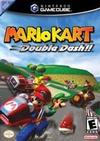
Mario Kart: Double Dash!!
- Developer
- Nintendo
- Publisher
- Nintendo
- Genre
- Driving
- Players
- 1-4
- Rated
- Teen
- Released
- 11/17/2003
"Double Dash didn’t want to push the envelope, but it certainly changed the way you think with the innovative two-racers per kart idea."
Mario Kart originally debuted on the NES in 1992 with ‘Super Mario Kart’, and has made an appearance on every Nintendo console since. The most recent being Nintendo 64’s ‘Mario Kart 64’, which hit shelves late 1996 and became an instant success. Seven years and five Mario Party’s later, Nintendo finally commits to making a sequel based on its N64 brethren.
Mario Kart: Double Dash!! improves upon the 64 version with revamped visuals and a new innovative way to race (2 players for one kart). “Grand Prix” mode, where the bulk of the game is, lets players compete for different cups. At the beginning there are only 3 cups; Mushroom Cup, Flower Cup, and the Star Cup. There are 2 more unlockable cups and each cup is made up of four circuits that require three laps (or 2 if the course is fairly long) to complete. And at the beginning of the game, the roster of all-star racers include: Mario, Luigi, Peach, Daisy, Baby Mario, Baby Luigi, Yoshi, Birdo, Diddy Kong, Donkey Kong, Bowser, Baby Bowser, Warluigi, Wario, Koopa, and Paratroopa. There are 4 more unlockable characters, and each character fits into their respective weight class (light, medium, heavy). There is also three different difficulty levels; 50CC, 100CC, and 150CC. The different levels of CC determine how fierce the computer player’s race and how fast the vehicles go.
N64 veterans will most likely fly through 50CC without placing anything below 2nd, since the controls haven’t changed dramatically, but to most players 50CC will serve somewhat as a tutorial. 100CC is where the challenge beings, and enemy racers begin to look like humans than they do computers. It will take you quite a while to win all the cups on 100CC, but on your journey you’ll unlock new circuits, players, and karts. Once you get to 150CC, you’ll begin placing pretty close to last unless you can master the power-slide technique.
Power sliding is integral to master in Double Dash, if you plan to get anywhere. To power-slide, simply hold the L or R triggers while turning. Doing so will release yellow sparks from your wheels and you’ll begin to power slide. With some wiggling of the control stick the sparks will go red and them turn blue. If you can hold your powerslide onto blue, you’ll get a short boost when releasing the trigger. You can control the power-slide’s to the extent of avoiding bombs and other hazards but you certainly can’t hold onto the triggers for too long. Mastering the art of the power-slide will quickly net you first in the 150CC matches, since it’s vital to your progress.
Visually, Double Dash is very impressive on an overall basis. Detailed character models, and impressive graphics certainly make the races look good. And all the levels are packed with that nostalgic Nintendo vibe found in all modern Mario games. But it’s the incredible frame-rate that truly shows off Mario Kart’s visuals. Even with 4 players in multiplayer, the frame rate rarely shows a hiccup, and only when everyone on screen is dropping bombs at the same time. However, as nice as the game looks, the simple and unimaginative level designs certainly drag the overall feel of the game down. There are a few brilliant track designs, one for example being the DK Mountain: where you get shot out of a barrel and sky rocket to the top of a volcanic mountain only to come racing back down to the bottom on steep cliffs. But for the most part, the level of creativity expressed in most of the earlier stages will likely disappoint. It certainly gets the job done and the levels are definitely fun, but it’s not something you’d expect in a first party Nintendo game.
The audio quality isn’t as impressive as Double Dash’s look, but it certainly gets the job done. Environmental ambience usually adds to the race, and all the sounds of bombs going off and turtle shells being chucked, sound appropriate. And each character has a few lines to say, though they’ll say them one too many times if you don’t constantly change who your riding with. Luckily, every game in Double Dash requires 2 racers to one kart, so you’ll get some sort of variety. And it’s fun to experiment with different racers to see what they look like (Mario and Peach, Bowser and Mario, Warluigi and Luigi) It would have been nice to see some communication going on between characters while racing though, that would certainly clear up the tedious comments.
The gameplay is what truly makes Mario Kart: Double Dash!! stand out from the crowd though, and this time around it’s two racers per kart. You can decide to control both characters, alone which is surprisingly easy, or you can team up with a buddy. Racing with a buddy is much more exciting than racing alone, and the whole “2 racer” idea truly changes the way you play the game. At first; controlling the kart, controlling the items, watching where you’re going, and who your hitting may seem a bit overwhelming. But once you master the controls and how to power-slide everything becomes a whole lot easier.
As great as the single player campaign is in Mario Kart, it does get a bit stale after a few weeks. You’ll only want to go back to your favorite tracks if you’re going at it alone. But luckily Mario Kart: Double Dash!! happens to include some of the greatest multiplayer action the Cube can offer. Double Dash includes 3 modes of multiplayer; Versus, Grand Prix, and Battle. Versus is your standard head to head races, where up to 4 players can compete in either 4 player split screen or 2 player split screen. Grand Prix is the same except you’re also racing along computer enemies. And Battle is your typical Mario Kart deathmatch, where the player’s main goal is to destroy the other players instead of winning a race. There are not that many levels in the “Battle” mode, unfortunately, and the few there are rather plain and desolate. But with 4 players in Mario Kart, any level suddenly becomes pure chaotic fun. Mario Kart also supports LAN play, so if you have the right equipment you can play with up to 8 players at once.
Double Dash certainly didn’t want to push the envelope when it came to the Mario Kart formula, but it certainly changed the way you think with the new innovative two-racers per kart idea. And with revamped visuals, and an extremely deep multiplayer component, it’s hard not to recommend this title. It’s definitely worth your time, even if you don’t plan to use the multiplayer often. But if you do intend to use Double Dash as a party game frequently, the more fun for you!